

It Probably Wasn't You
You've probably blamed yourself. The role went to someone more experienced. Someone who interviewed better. Someone who knew someone. Maybe. But there's another possibility nobody talks about: your CV never made it to a human at all.
Most applications are filtered by software before a recruiter sees them. Not skimmed — literally filtered, automatically. And most CVs, including well-written ones, are losing that fight for reasons that have nothing to do with experience or qualifications.
Most people don't know this is happening. They assume rejection means they weren't qualified enough. There are two audiences every CV has to get past: the software that filters first, and the recruiter who gets seven seconds to decide if it's worth reading further. And most CVs are written for neither.
This article explains what both of them are actually looking for, and why a beautifully designed CV can be the thing that gets you rejected before anyone sees it.
Two Audiences. One Document.
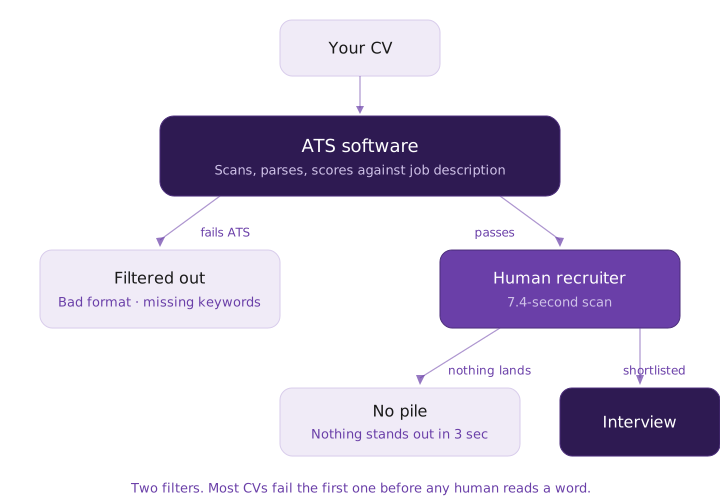
When you apply for a job online, your CV doesn't land on a recruiter's desk. It lands in a queue, usually inside an Applicant Tracking System (ATS), where software scans it before any human does. Only if it passes that first filter does it move on to an actual person.
That person then has about seven seconds.
A 2018 eye-tracking study by TheLadders found that the average initial scan lasts 7.4 seconds — enough to catch a name, a job title, a company or two, and a rough sense of whether the layout is readable. If it passes that scan, it gets a second, longer read. If it doesn't, it goes in the no pile before anyone has registered what you've actually done.
The dual-audience problem is this: the same document has to get past a machine and impress a human. Those two audiences don't always want the same things. A CV optimised entirely for one often fails the other.
How Widespread Is ATS, Actually?
More widespread than most people assume. Around 98% of Fortune 500 companies use an ATS to screen applications. Among large companies with 500 or more employees, adoption sits at roughly 89%. Even 60% of small businesses with fewer than 50 employees now run applications through one.
That doesn't mean every application you send goes through automated screening — smaller companies and direct referrals are different. But if you're applying online to a medium or large employer, the chances that your CV hits an ATS first are high enough that it's worth understanding how they work.
What ATS Software Is Actually Doing
ATS doesn't read your CV the way a person does. It parses it — extracting text, matching it against the job description, and looking for specific keywords, section headings, and formatting cues. It's less a reader than a scanner looking for signals.
Which means a few things that seem harmless can quietly cause problems:
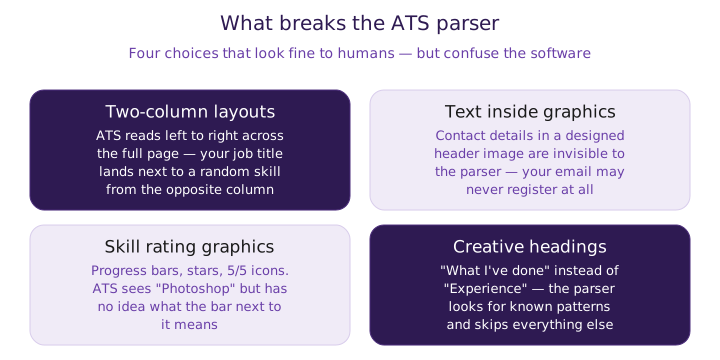
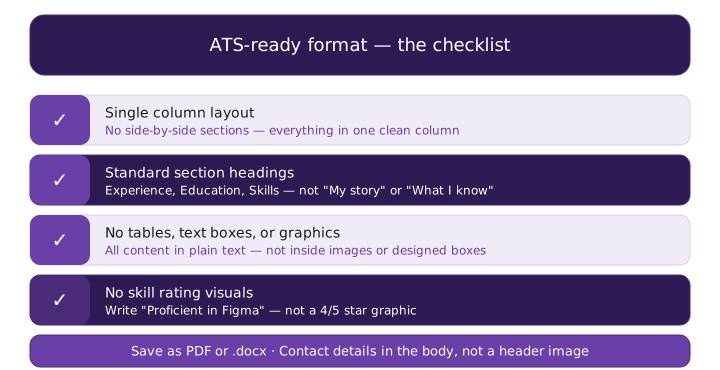
- Tables and columns. ATS often reads left-to-right across the full width of a page. A two-column layout can get parsed as a single scrambled line, putting your job title next to someone else's skill set.
- Text inside graphics or images. Invisible to the parser. If your contact details are in a designed header, they may not register at all.
- Skill rating graphics — progress bars, star ratings, 5/5 graphics. The ATS reads the label but not the visual. It sees the word 'Photoshop' but has no idea what the bar next to it means.
- Non-standard section headings. 'What I've done' instead of 'Experience', 'Things I know' instead of 'Skills'. The parser is looking for known patterns. Creative headings often just get skipped.
A 2025 analysis of 1,000 rejected CVs across major ATS platforms found that plain single-column layouts had a parsing accuracy of around 93%, compared to 86% for two-column formats. That gap is the difference between your experience being read correctly and being scrambled.
The Graphic Designer Problem
Someone in a creative field — design, marketing, communications — puts real effort into making their CV look impressive. Custom layout, colour, icons, a skills section with visual ratings. It looks genuinely good. It also fails ATS at almost every point.
The columns confuse the parser. The icons and graphics contain text the system can't read. The skill ratings register as decorative noise. By the time the CV reaches the parser, half the information has either been scrambled or dropped entirely. The recruiter who eventually sees it — if they see it — gets a mangled version of what was submitted.
This is one of the most common reasons strong candidates get filtered before anyone reads their actual experience. For a closer look at why a beautifully designed template scrambles inside the parser — and how the GDPR loophole still lets it get rejected — see why they'll never read your beautiful CV.
What a CV Needs to Get Past Both Audiences
The good news is that making a CV ATS-readable doesn't mean making it boring. It means making it clean. There's a difference.
None of that prevents a CV from looking professional. A clean, well-spaced single-column layout with clear headings and readable type reads better than most designed CVs — to a human and to a parser.
Keywords: The Part People Get Wrong
ATS software matches your CV against the job description. The closer the language, the better the match. That means tailoring your CV to each role isn't optional — it's working with how the system is designed.
The goal is a CV that reads naturally to a person but is also legible to a machine.
This doesn't mean stuffing your CV with keywords until it reads like a job posting. It means using the same language the employer uses. If the job description says 'stakeholder management', use that phrase. If it says 'cross-functional collaboration', use that. The ATS is matching strings of text, not inferring meaning.
A few specific places to make sure your keywords appear:
- Your professional summary — this is the first thing the parser hits
- Job titles — make sure yours match recognisable industry terms, not just internal titles
- Bullet points — use the language of the role, not just the language of your company
- A dedicated skills section — makes it easier for both the ATS and the human to find what they need
| ATS reads this correctly | ATS cannot read this |
|---|---|
| Plain text in the document body | Text inside image headers or footers |
| Standard headings: Experience, Skills | Creative headings: 'My story', 'What I know' |
| Keywords in bullet points | Text inside progress bars or star icons |
| PDF or .docx body text | Content inside tables or text boxes |
| LinkedIn URL as plain text | Two-column layout — content gets scrambled |
What Happens After the ATS
Assuming your CV gets through, it reaches a recruiter — and that's where the 7.4-second scan kicks in. In that window, they're not reading. They're looking. Name, current role, company, rough career arc, one signal of scale or achievement.
The TheLadders eye-tracking research found that recruiters' attention clusters heavily in the top third of the first page and on the left margin. Content buried below the fold, or in a second column, often doesn't get seen in that initial pass.
Which means: your strongest material needs to be at the top, in a single column, with enough white space that the eye can move through it.
CVs that pass the initial scan get a longer look — closer to a minute and a half, according to the same research. That's the window where the actual content matters. But you only get there if the first seven seconds don't knock you out.
Check Yours Before You Send It
Before your next application, copy and paste your CV into a plain text editor. If the content comes out scrambled — sections out of order, information merged together — an ATS will read it the same way. That's the fastest check you have.
If the structure holds up, look at the first third of the first page. Is your most relevant experience visible immediately? Is the language close to what the job description uses? Those two things are what get a CV through both filters.
Most people don't lose out on jobs because they're underqualified — they lose out because their CV doesn't survive the systems designed to filter it. cvlift.ai builds clean, ATS-friendly layouts and helps you align your language to the job description you're targeting, so the format stops getting in the way of the experience underneath it.