
The First Bullet Test
Open your CV right now. Find your most recent job. Read the first bullet point. Chances are it starts with one of these:
- "Responsible for managing the client accounts team"
- "Assisted with the development of marketing materials"
- "Supported the implementation of a new CRM system"
Sound familiar? You're not alone, and it's not your fault. Nobody teaches us how to write about ourselves at work. So we default to describing our jobs the way our job descriptions described them: duties, responsibilities, scope.
The problem is that hiring managers already know what a Marketing Manager does. They've read 200 CVs this week from people with the same job title. What they actually want to know, and almost never get, is: how well did you do it?
That's the difference between a job description and an impact story. And it's the single biggest upgrade most CVs need.
The 'Responsible for' Problem
Passive language buries you. When you write 'responsible for X', you're telling the reader what you were supposed to do — which is already implied by your job title. It gives them no information about whether you were any good at it.
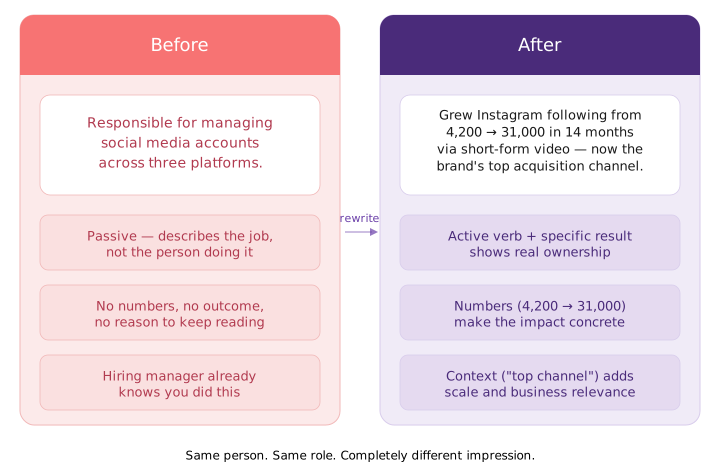
Compare these two bullets for the same person, same job:
Same person, same role, but completely different impression. The first bullet says I showed up. The second says I made a difference. One of those gets you an interview.
Numbers Make You Memorable
In a stack of 200 CVs, specific figures are the thing that actually stick. A recruiter who has been reading generic bullets for three hours will stop on a number almost every time.
A 2018 eye-tracking study by TheLadders found that while the average initial scan lasts around 7.4 seconds, CVs that pass that first cut get a second, longer read — and that follow-up time is spent almost entirely on verifying quantifiable results and job titles.
That's backed up by hiring manager surveys too: 34% say that a lack of measurable results is a dealbreaker — not because the candidate wasn't qualified, but because there was nothing concrete to hold onto.
The reason is simple. Numbers are concrete. They give the reader something to hold onto. 'Improved customer satisfaction' means nothing. 'Raised NPS from 32 to 61 over two quarters' is a story with a beginning, a middle, and an outcome.
This doesn't mean every bullet needs a percentage or a revenue figure. It means every bullet needs to answer the question: so what happened?
What to Do When You Don't Have Hard Numbers
This is the most common objection: 'I don't track metrics. I'm not in sales. I don't have numbers.'
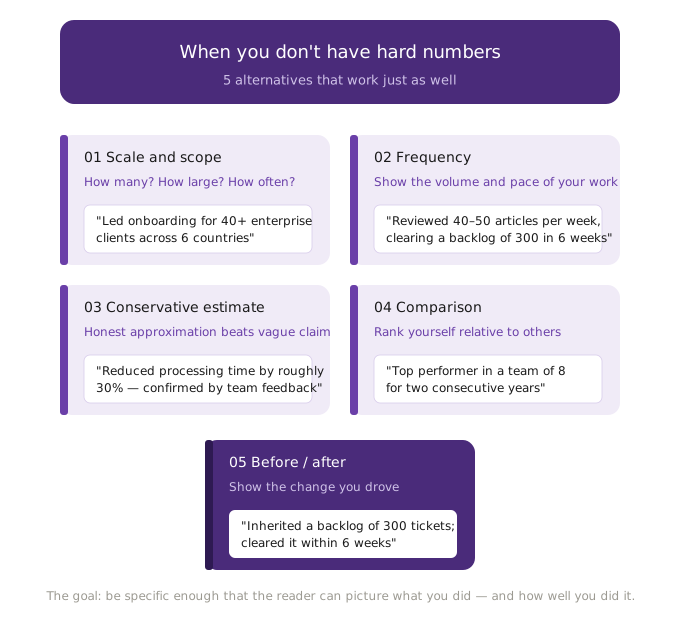
You have more than you think. You just have to look for them differently. When a hard metric isn't available, try one of these instead:
The goal is to be specific enough that the reader can picture what you actually did, and how well you did it.
Match Your Verbs to Your Level
One detail that often gets overlooked: the action verb at the start of your bullet should reflect where you sit in the organisation.
| Level | Verbs that fit |
|---|---|
| Individual contributor | Built · Delivered · Produced · Executed · Analysed |
| Manager / team lead | Led · Managed · Coordinated · Developed · Mentored |
| Senior / director level | Established · Transformed · Defined · Drove · Oversaw |
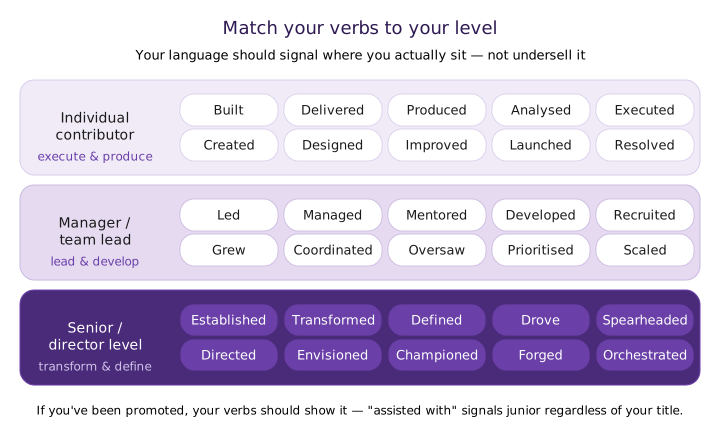
If you've been promoted, this matters more than you think. A senior manager who writes 'assisted with' or 'supported the development of' is inadvertently signalling junior. Your language should match your actual level of responsibility — not modestly undersell it.
A Simple Formula to Rewrite Any Bullet
If you want a starting point, use this:
Example:
→ Redesigned the onboarding process for new clients [action + what], cutting average time-to-value from 6 weeks to 11 days [result], across a portfolio of 40+ enterprise accounts [context].
You won't always have all four parts, and that's fine. Even two is better than a task list. The point is to shift the frame from 'here's what my job was' to 'here's what I did with it.'
If You've Been Promoted, Your CV Probably Doesn't Show It
This one's worth calling out separately, because it catches a lot of mid-career professionals off guard.
You've grown. You've taken on more. Maybe you've moved from individual contributor to managing a team, or from team lead to department head. But if your CV still reads like a list of tasks — especially for your earlier roles — that progression is invisible on paper.
Two things help here:
- Write the older roles with less detail. Two or three strong bullets maximum, focused on the most impressive outcomes. The older the role, the more ruthlessly you can edit it.
- Make sure your most recent role reads clearly as the most senior. More responsibility should mean more ownership language — led, defined, transformed — not just more bullets.
Your CV should show a career that's going somewhere, not a flat list of things you've done.
Try It on Your Own CV
Pick the worst bullet on your current CV — the one that starts with 'Responsible for' or 'Helped with' — and rewrite it using the formula above. You might be surprised how much better it reads with a single specific detail.
If you want a bit of help getting there, cvlift.ai's AI suggestions are built exactly for this. Describe what you did in plain language and it'll help you shape it into something a hiring manager will actually stop and read.