
Breaking into a new international job market requires more than just translating your resume. The corporate cultures, hiring algorithms, and legal frameworks in Europe and the United States operate on entirely different frequencies. What gets you hired in Berlin might get your resume auto-rejected in Silicon Valley.
Throughout this guide, we use Germany as the primary baseline for the European market, because Germany represents the ultimate stress test. It is known for having the most rigid corporate culture, the heaviest bureaucracy, and the strictest labor laws. If you can successfully navigate the German hiring system, you are structurally prepared for almost anywhere else.
1. What Employers Actually Want: Depth vs. Scale
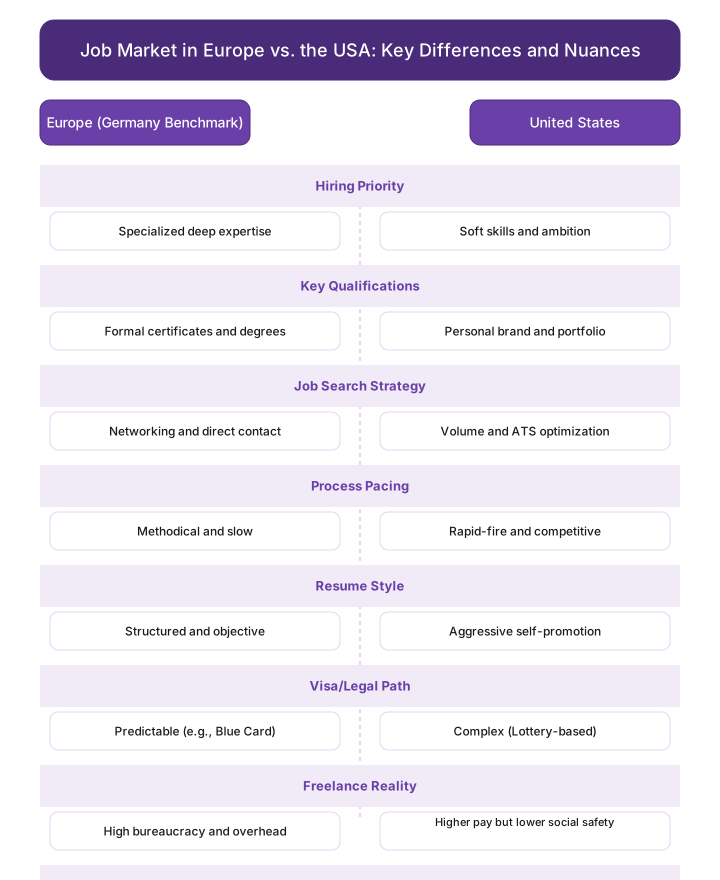
The fundamental difference between the two markets lies in how they evaluate a candidate's core value. In Europe, employers highly value deep, narrow expertise over a "jack-of-all-trades" approach. If you are in marketing, for example, being generally good at everything is less appealing than having mastery in a specific vertical like performance marketing, SEO, or CRM. While a local diploma isn't strictly mandatory for private businesses, professional certifications act as strong trust signals.
Conversely, the US market is heavily driven by ambition, adaptability, and cultural fit. Soft skills often carry as much weight as hard technical skills. Your digital footprint is essentially your secondary resume. A strong personal brand, an active LinkedIn presence, or a well-maintained GitHub repository are often deciding factors. You need to know how to sell your achievements aggressively—a skill that candidates from other regions often need to practice.
2. The Application Machine: Networking vs. Volume
Both markets are highly competitive, but the way you reach the hiring manager differs drastically. In Germany and many neighboring countries, relying solely on job portals can lead to a dead end. Decisions are frequently made through direct contact and internal recommendations. Reaching out directly to an HR manager or a Department Head on LinkedIn often yields much better results than submitting a standard application form. Networking via local meetups and industry conferences is a highly effective backdoor into the market.
The US application process, on the other hand, is a numbers game heavily guarded by Applicant Tracking Systems (ATS). A single role at a top tech company can attract thousands of global applicants. To survive the initial filter, your resume must be flawlessly formatted and injected with the exact keywords from the job description. The volume of applications required is high, but candidates with a strong personal brand and strategic networking can cut this number down significantly.
3. Visas and The Legal Reality
Immigration bureaucracy is the hardest filter in both regions, offering entirely different pathways. Germany provides a structured, predictable path to residency, like the EU Blue Card, if you meet specific salary and qualification thresholds. However, for regulated professions, formal diploma recognition is a non-negotiable legal requirement.
The US immigration system is notoriously complex and heavily relies on chance. Visas like the H-1B are distributed via a lottery with roughly a 30% success rate, and many job descriptions explicitly state they are strictly for US residents. Because of these barriers, the most realistic entry points into the US market are often internal L-1 transfers within a global corporation, or working remotely for a US company through global payroll providers.
4. Freelance vs. Full-Time: The Hidden Costs
For newcomers, the choice between freelancing and traditional employment should be weighed carefully. Freelancing in Europe comes with heavy bureaucracy, complex taxes, and mandatory health insurance costs. Many freelancers end up earning less than expected because they fail to calculate their overhead. For recent immigrants, securing a full-time contract is highly recommended to gain access to paid leave, social security, and vital local market experience.
In stark contrast, the US market is much more accustomed to contract work. Because the social safety net is lighter, the financial compensation for both full-time and contract roles is significantly higher.
5. Stepping Stones and Alternative Routes
If landing a mid-to-senior role immediately isn't feasible, both markets offer transitional steps. In Europe, taking on mini-jobs, volunteering, or working through temp agencies can be viable bridges to get official local work experience, provided you treat them strictly as stepping stones. Vocational training is also a great path for a career change, though it requires a multi-year commitment on a low stipend.
For the US market, targeting mid-size tech companies and startups that hire globally is often the smartest strategy. They care less about your physical location and more about your ability to work US hours and deliver results.
6. Beyond Germany: The Broader European Context
While Germany serves as our ultimate stress test, Europe is not a monolith, and conditions vary significantly across borders. The Netherlands or Scandinavia, for instance, offer flatter hierarchies and more English-first opportunities, whereas markets like France or Italy heavily rely on local language fluency and traditional networking.
Despite these regional differences, several fundamental rules apply across the entire European job market:
- Expertise over versatility: Employers universally prioritize deep, specialized knowledge over generalist skills.
- Factual presentation: CVs must be highly structured, objective, and strictly professional, avoiding the aggressive self-promotion and "hustle" typical of the US market.
- Deliberate pacing: Strong social protections, mandatory notice periods, and a focus on work-life balance dictate a much slower, more methodical hiring process compared to the rapid-fire US system.
7. How to Choose the Right Country
Deciding where to relocate is a high-stakes decision that requires a structured approach rather than guesswork. Start by identifying your non-negotiable criteria—such as labor market potential, cost of living, taxation, climate, healthcare, and educational infrastructure for children. Use a weighted scoring system: rank your chosen countries against these criteria, assigning a priority score to each, and create a shortlist of 2–3 top contenders. If possible, visit your shortlist candidates in person before making a final commitment. Tools like Numbeo or Cost of Living Calculator can provide the necessary data for your financial analysis.
The Bottom Line
Searching for a job in a new country is a marathon, not a sprint. Whether you choose the structured, methodical path of Europe or the high-stakes, competitive velocity of the US, success depends on moving from "being busy" to "being productive."
Define your strategy, treat your career transition like a professional project, and remain adaptable. Both markets offer immense rewards for those who understand their mechanics, respect their unique cultures, and prepare with discipline. Choose the environment that aligns with your professional goals and your personal definition of stability.