

The problem isn't your experience
If you've been applying for roles you're clearly qualified for and hearing nothing back, the problem probably isn't your experience. Here's an uncomfortable fact from our recruiter: most hiring managers spend less time reading your CV than you spent choosing the font.
Seven seconds. That's the average initial scan. In that time they're not really doing deep reading. They're looking for signals. Your job title. Company name. Something that stands out. If those signals aren't there immediately, the CV goes down and the next one comes up.
In this article we'll share with you the five things that actually move your CV from the rejection pile to the interview shortlist: structure, tailoring, impact, formatting, and editing. Each one will be explained as simply as it sounds.
| Generic CV | Tailored CV | |
|---|---|---|
| Interview conversion rate | 2.68% | 5.75% |
| Interviews per 100 applications | Fewer than 3 | ~6 |
| Recruiter preference | 37% | 63% |
Source: Huntr Q2 2025 Job Search Trends Report (1.39M applications) · Recruiter surveys
Most people who aren't getting interviews aren't underqualified. They're under-communicated. Their CV lists what they did without making clear why it matters. It often positions experience in the wrong order for the role and reads more like a job description than a case for hiring someone.
The hiring manager looking at your CV doesn't know you. They have roughly seven seconds to decide whether you're worth reading further. At that moment, like we've shared above, they're not going deeper through your CV. They only do quick skimming, looking for your essential information: job title, company, or even a sense of career progression. If those signals aren't visible immediately, the CV gets put down.
One career platform research analysis of 1.39 million applications found that tailored CVs converted to interviews at roughly twice the rate of generic ones, 5.75% versus 2.68%. That gap isn't explained by qualifications. It's explained by how clearly the CV speaks to the specific role.
1. Get the structure right first
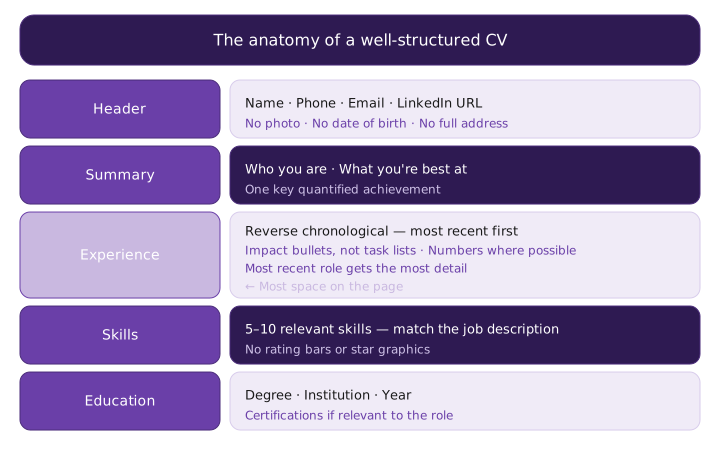
Before anything else, your CV needs a structure that's readable by both humans and ATS software. A recruiter who can't find your job titles in three seconds moves on. An ATS that can't parse your sections drops you before anyone reads a word.
A few things that don't belong: photos (they introduce bias and serve no purpose in most markets), personal pronouns in the summary, full street address, and references like for example: 'available on request' is implied and wastes a line.
The professional summary is worth taking seriously. Most are either missing or generic. A good one has three things: who you are professionally, what you're particularly strong at, and one achievement that signals the level you operate at. Three sentences. Specific. Written for the role you're applying to, not for every role you might ever apply to.
2. Tailor it. Every time.
63% of recruiters say they prefer CVs tailored to the specific role over generic submissions, according to research across hiring professionals. So, sending the same CV to every role is the single most common reason qualified people don't get interviews. Not because generic CVs are bad, but because tailored ones are measurably better.
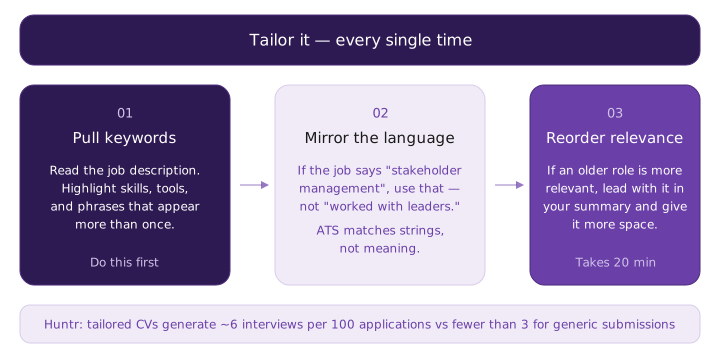
And since ATS software matches your CV against the job description word for word, a CV that mirrors the employer's language scores higher before a human even sees it.
Tailoring doesn't mean rewriting from scratch. It means three things:
- Pull keywords directly from the job description and make sure they appear naturally in your CV, for example, in your summary, your bullets, or your skills section.
- Mirror the language the employer uses. If they say 'stakeholder management', use that phrase. If they say 'revenue growth', use that. Don't paraphrase, as the ATS is matching strings, not meaning.
- Move your most relevant experience to where it gets seen. If a role from three years ago is more relevant than your current one, lead with that in your summary and give it more space in your experience section.
This takes 20 minutes per application. It's the highest-return thing you can do to your CV.
3. Show impact, not tasks
The most common thing missing from CVs isn't experience, but evidence. Listing what you were responsible for tells the recruiter what your job was. It doesn't tell them how good you were at it.
TalentWorks found that including quantified achievements in a CV increases the chance of getting an interview by around 40%. Numbers are the only thing on a CV that doesn't blur after the third read, everything else starts to look the same.
The rewrite is usually simpler than people expect:
When you don't have a clean number, use the proxy: scope, frequency, before/after, conservative estimate, or comparison. 'Managed a team of six' is a number. 'Highest-performing quarter in three years' is a number. 'Cleared a backlog of 300 tickets in six weeks' is a number. You have more to work with than you think.
A useful frame for each bullet: what did I do, and what happened as a result? If you can't answer the second part, the bullet probably isn't earning its place.
4. Keep formatting simple and scannable
A CV that's hard to read doesn't get read. That sounds obvious, but most formatting mistakes aren't obvious to the person making them. The basics that consistently get ignored:
- One or two pages maximum. One for under 10 years of experience. Two if you have more and it's all relevant.
- Standard fonts at 10–12pt. Arial, Calibri, Georgia. Anything decorative is a distraction.
- Consistent formatting throughout. Same heading style, same bullet style, same date format. Inconsistency reads as careless.
- Save as PDF unless the job posting asks for something else. PDFs preserve formatting across systems and are widely supported by ATS.
One thing worth adding: white space. The TheLadders eye-tracking research found that cluttered layouts with little white space were among the worst-performing CVs, not because the content was weak, but because the layout made it impossible to find. Margins of at least 0.75 inches, line spacing of 1.0 to 1.15, and clear section breaks cost you nothing and make everything easier to read.
5. Cut more than you think you need to
Most CVs are too long not because people have too much experience, but because they haven't decided what to leave out. Everything that's still on the page feels earned, but the recruiter doesn't know that, and they're not going to read all of it to find out.
A few things that almost always belong on the cutting room floor:
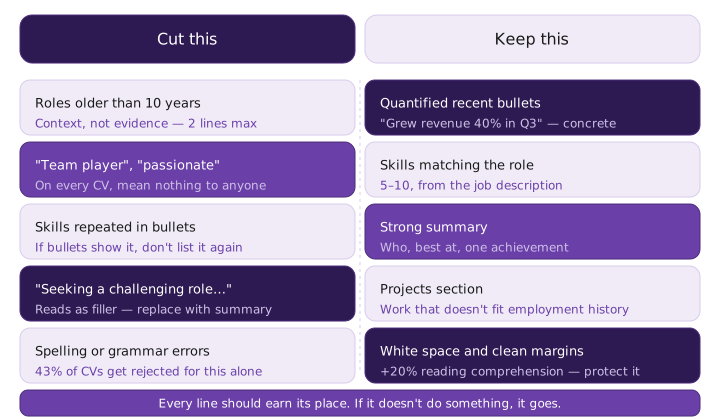
- Anything beyond the last 10 years, unless it's genuinely relevant to the role you're applying for.
- Weak or generic bullets. e.g., 'Assisted with', 'Helped to', 'Supported the team in'. If it doesn't say something specific, it says nothing.
- Clichés. 'Team player', 'results-driven', 'passionate about', 'strong communicator'. Every CV has these. None of them mean anything.
- A long objective statement. If you have relevant experience, a professional summary does the work better. Objective statements belong on career-change CVs, not mid-career updates.
The editing test: for every bullet, ask whether a hiring manager who's seen 200 CVs today would find this useful or impressive. If the honest answer is no, cut it. The CV you're left with will be shorter and stronger.
| Cut this | Because |
|---|---|
| Roles older than 10 years | Context, not evidence — 2 lines max |
| "Team player", "passionate", "results-driven" | On every CV, mean nothing to anyone |
| Skills already shown in your bullets | Redundant — wastes space, adds no signal |
| "Seeking a challenging role where I can…" | Reads as filler — replace with a real summary |
| Weak bullets from old roles | If it doesn't say something specific, cut it |
| Spelling or grammar errors | 43% of CVs get rejected for this alone |
One more thing: proofread it
Around 43% of CVs are rejected because of spelling errors or grammatical mistakes, according to research across hiring professionals. That's a significant number of people being filtered out for something that has nothing to do with their ability to do the job.
Read it once normally. Then read it backwards, sentence by sentence, to catch things the eye skips over when it knows what's coming. Then have someone else read it. Spell-check catches typos, not missing words or wrong-but-correctly-spelled substitutions.
Also check: consistent tense (past tense for previous roles, present for current), no first-person pronouns, and that every date, title, and company name matches your LinkedIn profile. Discrepancies get flagged.
Start with one section
Open your CV now. Pick one section, the professional summary, or the bullets in your most recent role, and rewrite it using the principles above. Lead with impact, use the employer's language, cut anything that doesn't earn its place.
One section done properly is usually enough to see what the rest needs.
This article is brought to you by CVLift.ai. Most people who aren't getting interviews aren't underqualified, but their CV isn't doing enough work on their behalf. Getting structure, tailoring, impact, and formatting right at the same time, for every application, is more than most people have time for.
CVLift is an AI-powered CV builder that handles the parts that slow most people down. Choose from clean, ATS-friendly templates, import directly from LinkedIn, and use AI-powered suggestions to sharpen your bullets and match your language to the job description you're targeting. The result is a CV that's structured, specific, and ready to send, without the three-hour rewrite.
Our mission is to help people unlock better career opportunities. Your experience should be enough to get you in the room. cvlift.ai helps make sure your CV says so. Try it free at cvlift.ai now!