
The ultimate goal of your CV is not to document everything you have ever done. Its purpose is to secure an interview. Yet many highly qualified professionals get filtered out early because their resumes are either too generic, too dense, or too focused on daily chores.
Let's learn about the four pillars of building a high-converting CV, from managing your core document to proving your senior-level impact.
Build a master CV (and tailor it in fifteen minutes)
Relying on a single, generic CV often dilutes your strongest specific skills, making you look like a generalist. Conversely, rewriting your resume from scratch for every application is a fast track to burnout.
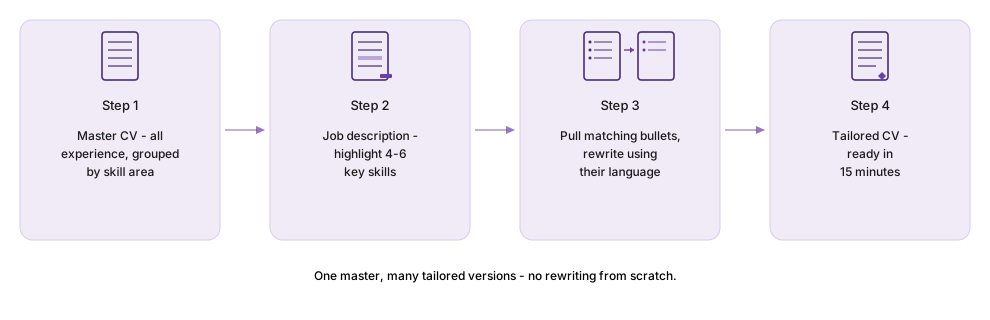
The most sustainable strategy is creating a master CV, a comprehensive, multi-page, private document containing every project, metric, and bullet point from your entire career. When applying for a role, you simply duplicate it and trim it down.
- The 15-minute tailor. Instead of rewriting, spend 15 to 20 minutes curating the master CV. Cut what is irrelevant and leave only the exact experience the employer needs.
- Natural mirroring. Identify 4–6 core skills or responsibilities repeated in the job description. Weave these exact keywords naturally into your bullet points and skills section. Don't make the recruiter translate "coordinated team initiatives" into "Agile project management"—use their words.
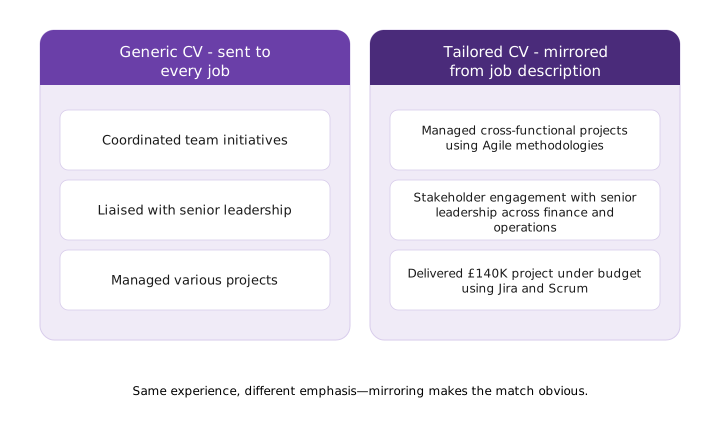
Reorder by relevance. Move your most relevant experience higher up on the page. Even if a specific project isn't your most recent, prioritising it visually helps you match the employer's immediate needs. Strict reverse-chronological order is a convention, not a rule.
Design for the six-second scan
Passing the ATS is only the first hurdle. Recruiters review CVs in seconds, frequently toggling between desktop and mobile screens. If your most critical information doesn't immediately catch the eye, the depth of your qualifications won't matter.
Dense walls of text, tiny fonts, and buried achievements create cognitive load and lead to rapid rejections. The solution lies in how your data is presented.
- 1–2 line bullets. Keep bullet points punchy. If a bullet spills into three lines, break it into two distinct points to ensure key results jump out immediately.
- Strategic white space. Let the document breathe. Generous margins and spacing between sections guide the reader's eye, even when page real estate is tight.
- Clear visual hierarchy. Your job titles, company names, dates, and top achievements must be the most easily scannable elements on the page. Clarity will always outperform cramming everything onto a single sheet.
Make your career progression obvious
Many mid-career professionals are bypassed for senior roles because their CV reads like a junior task list, inadvertently hiding years of growth. To land senior-level interviews, your progression must be immediately obvious to someone scanning your profile.
- Showcase promotions. Group roles within the same company clearly to demonstrate upward mobility, expanded scope, and the ability to handle larger projects. If you've been promoted or changed focus areas, make sure the trajectory is readable at a glance.
- Elevate your vocabulary. Junior employees execute tasks; senior professionals drive business outcomes. Shift your language to match the level you are targeting, rely on executive verbs like led, owned, strategised, or architected rather than assisted, supported, or helped with.
- Match the scope. Analyse job descriptions at your target seniority level to ensure the scale of your past work—team size, budget, revenue impact—aligns with their expectations. If the role manages a team of twenty and your CV never mentions headcount, fill that gap.
Prove impact, don't just list responsibilities
The phrase "responsible for" tells a recruiter what you were hired to do, but provides zero insight into how well you did it. The difference between securing an interview and being ignored comes down to proving your competence through results.
- The impact formula. Rewrite every bullet point using the structure: Action + Context + Result. Replace vague duty descriptions with specific outcomes. "Managed the marketing budget" becomes "Managed a £200K marketing budget, reducing cost-per-lead by 30% over six months."
- Find measurable evidence. Even if you don't have exact revenue numbers, you can quantify your impact. Use percentages, timeframes, ranges, or frequency, reduced processing time by 20%, managed a cross-functional team of 15+, delivered three product launches in one quarter.
- Prioritise ruthlessly. Focus your energy on perfecting your top 10 to 15 bullet points across the entire document. A few powerful, quantifiable impact statements will always carry more weight than a long list of passive responsibilities.
Treat it as a marketing asset, not a biography
A successful CV operates exactly like a high-converting landing page. It doesn't need to tell your entire life story—it needs to deliver the right message to the right audience in a matter of seconds.
By maintaining a master CV for efficient tailoring, designing for strict scannability, showcasing clear career progression, and backing your responsibilities with hard metrics, you eliminate the friction between your application and the recruiter.
Avoid passive task lists. Write impact statements. The hiring system can be tough, but once you understand how to navigate the algorithms and human filters, you start landing the interviews.